
Accessories · Metal roof
Complete Roofing System Accessories: How They Reduce Labor Costs and Eliminate Installation Errors
- Published:
- Author: BRAVO INTERNATIONAL
- 7 min read
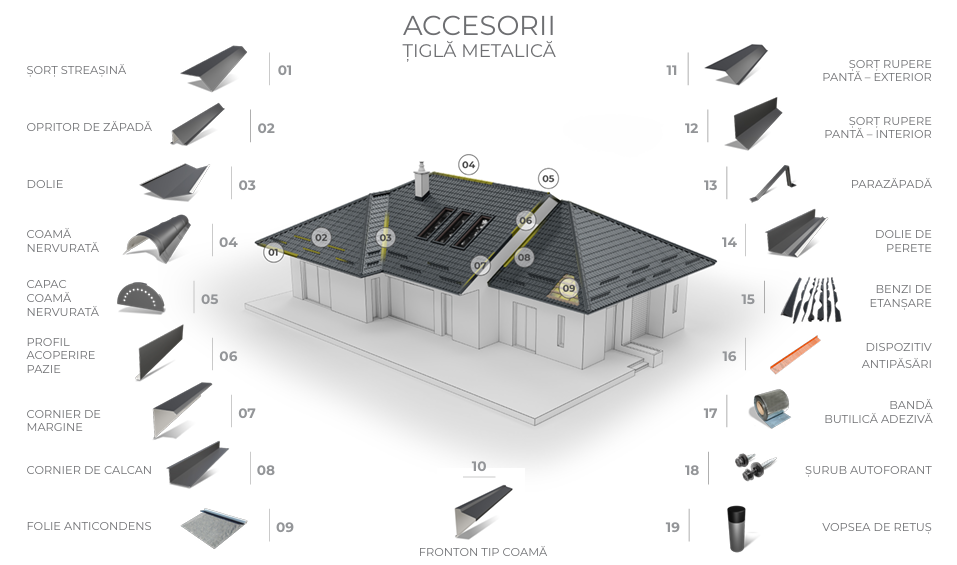
Accessories Are Not “Optional” — They Are Part of the System
One of the most common mistakes when installing metal roofing is treating accessories as a separate category, to be considered only after the roofing sheets have been purchased. In reality, a high-performance metal roof is not simply the sum of the products ordered, but an integrated system in which every component has a defined role — and where missing parts or improvised solutions at any point can compromise the entire installation.
Experienced installers know that the right accessories, belonging to the same system as the roofing sheets, are not merely a guarantee of aesthetic consistency — they are tools for greater efficiency. Pre-formed, pre-coated and specifically sized components eliminate hours of on-site adjustments and reduce the risk of errors that can lead to complaints or costly repairs.
This approach — considering accessories an integral part of planning rather than a last-minute addition — makes the difference between a project completed on schedule and one that costs additional time and damages professional reputation.
Components of a Complete System and Their Technical Roles
Ridge Cap — The Critical Point at the Roof Peak
What it is: The ridge cap is a formed metal component that covers and seals the upper edge of the roof, where the two roof slopes meet. This is one of the areas most exposed to water, air and pest penetration.
Technical role: Mechanical sealing of the intersection between roof planes, rainwater management and wind protection. An incorrectly installed or improvised ridge cap is a common source of leaks and allows birds or insects to enter the attic.
Impact on installation labor: A ridge cap from a standardized system is pre-formed to match the metal tile or roofing sheet profile. Installers using BELPROFILE ridge caps no longer waste time manually adapting or securing incompatible edges — the component fits directly into position, with the correct overlaps.
System accessories are designed like puzzle pieces: each one fits precisely with the product for which it was developed. Manual adaptation is not a solution — it leads to wasted time and potentially compromises the roof.
Ventilated Ridge Cap — Managing Moisture Within the Roof Structure
What it is: A ventilated ridge cap is a ridge component featuring integrated ventilation openings or mesh that allows water vapor to escape from the roof structure.
Technical role: In a properly ventilated roof, air circulates from the eaves (inlet) toward the ridge (outlet). Without ridge ventilation, water vapor can accumulate within the structure, condense and gradually damage the roof decking and rafters. A ventilated ridge cap helps prevent these problems without additional interventions.
Impact on installation labor: Integrating ventilation directly into the ridge component eliminates the need for separate ventilation systems, reducing the number of individual elements to install and the number of roof penetrations.
Roof Valley — Managing Water at Roof Slope Intersections
What it is: A roof valley is a metal flashing profile, usually V-shaped or W-shaped, installed where two roof slopes meet or at the junction between a roof and a vertical wall. It collects rainwater and directs it toward the gutter.
Technical role: The roof valley is one of the areas exposed to the highest concentrations of water runoff — the volume of water flowing through it is significantly greater than across ordinary roof surfaces. An undersized or improvised valley can cause water to overflow and penetrate beneath the roofing sheets.
Impact on installation labor: BELPROFILE roof valleys are supplied with predefined widths and profiles designed to work with the roofing sheets. Installers do not need to cut, bend or adapt them extensively on site — the components are ready for installation. This saves significant time, particularly on complex roofs with multiple intersections.
Sealing Tape — Capillary Sealing
What it is: Sealing tape (butyl tape or expanding foam) is a flexible, watertight material applied beneath the ridge cap, at the eaves and at contact points between metal roofing and other surfaces.
Technical role: Profiled roofing sheets have a corrugated shape, leaving small gaps between the corrugations and the flashing components. Wind-driven rainwater or insects can enter through these openings. Sealing tape fills the gaps by conforming to the roofing sheet profile.
Impact on installation labor: Sealing strips pre-formed to match specific BELPROFILE roofing profiles can be installed quickly, without additional cutting or adjustments. Generic sealing strips require extra adaptation time and frequently result in incomplete sealing — a potential source of subsequent complaints.
Front and Rear Flashings — Finishing the Eaves and Wall Junctions
What they are: Front and rear flashings are formed metal profiles used to finish roof edges — at the eaves, around chimneys, along parapet walls or where the roof meets a facade. They provide a finished appearance and help prevent water, wind and pests from entering beneath the edges.
Technical role: Perimeter protection and aesthetic finishing. A roof without correctly installed flashing components is technically incomplete, regardless of how well the roofing sheets have been installed.
Impact on installation labor: System flashing components are pre-sized and designed for direct installation, without requiring on-site fabrication. Improvising these components from flat metal sheets adds hours of manual work and increases the risk of dimensional inaccuracies.
Snow Guards — Safety and Legal Responsibility
What they are: Snow guards are metal or stainless-steel bars or grids installed across the roof surface, parallel to the eaves, to retain accumulated snow and prevent sudden snow slides.
Technical role: Preventing sudden snow slides from roofs — a genuine risk to people, vehicles and equipment located near the eaves. In certain European countries, snow guards are mandatory under building regulations for specific types of structures.
Impact on installation labor and liability: BELPROFILE snow guards are designed for the relevant roofing system and supplied with mounting brackets compatible with the roofing profile. Their absence or the use of incompatible snow guards creates safety risks and, in the event of an incident, may expose installers to legal liability.
Rainwater Drainage System — Gutters and Downpipes
What it is: The rainwater drainage system includes gutters (horizontal profiles that collect water from the eaves) and downpipes (vertical sections that direct water toward the ground or drainage network), together with all connecting components, corners, end caps and connectors.
Technical role: Managing the entire volume of rainwater collected by the roof and directing it away from foundations and facades. An undersized drainage system or one assembled from incompatible components can cause leaks, facade damage and moisture accumulation around foundations.
Impact on installation labor: A rainwater drainage system from the same brand as the roofing provides color consistency (without visible mismatches) and compatible connections (mounting components designed to work together). Mixing systems from different brands often requires adapters or improvised solutions — resulting in wasted time and an increased risk of leakage.
System Thinking: How It Translates into Labor Hours Saved
A simple comparative case study: a 120 m² residential roof with two slopes and a chimney.
Fragmented approach (mixed accessories, without an integrated system):
- Adapting the ridge cap to the roofing profile: 2–3 hours
- Fabricating chimney flashing components: 1–2 hours
- Adjusting the valley flashing to the corrugated profile: 1 hour
- Repairing ridge leaks after the first rainfall: 2–4 hours (complaint)
- Estimated additional time: 6–10 hours
System approach (all BELPROFILE accessories, compatible with the selected roofing sheets):
- Ridge cap: direct installation, without adaptation
- Roof valley: installation according to instructions, without special cutting
- Flashing components: predefined geometry, quick installation
- No post-rainfall repairs if the system has been installed correctly
- Estimated savings: 4–8 hours per project
Across 10 projects per month, the difference amounts to 40–80 hours — equivalent to 1–2 working weeks that can be allocated to new projects.
Conclusion
Fully accessorizing a metal roofing system is not an additional expense — it is an investment in installation efficiency, finishing quality and the installation team's reputation. Components designed to work together eliminate improvisation, reduce errors and shorten installation time.
BELPROFILE offers a complete range of accessories — ridge caps, ventilated ridge caps, roof valleys, sealing tapes, flashing components, snow guards and rainwater drainage systems — designed to work together with the products in its portfolio.
Blog
Read also
Accessories · Metal roof
Snow guards for roofs: snow barrier or snow guard?
Accessories · Metal roof
