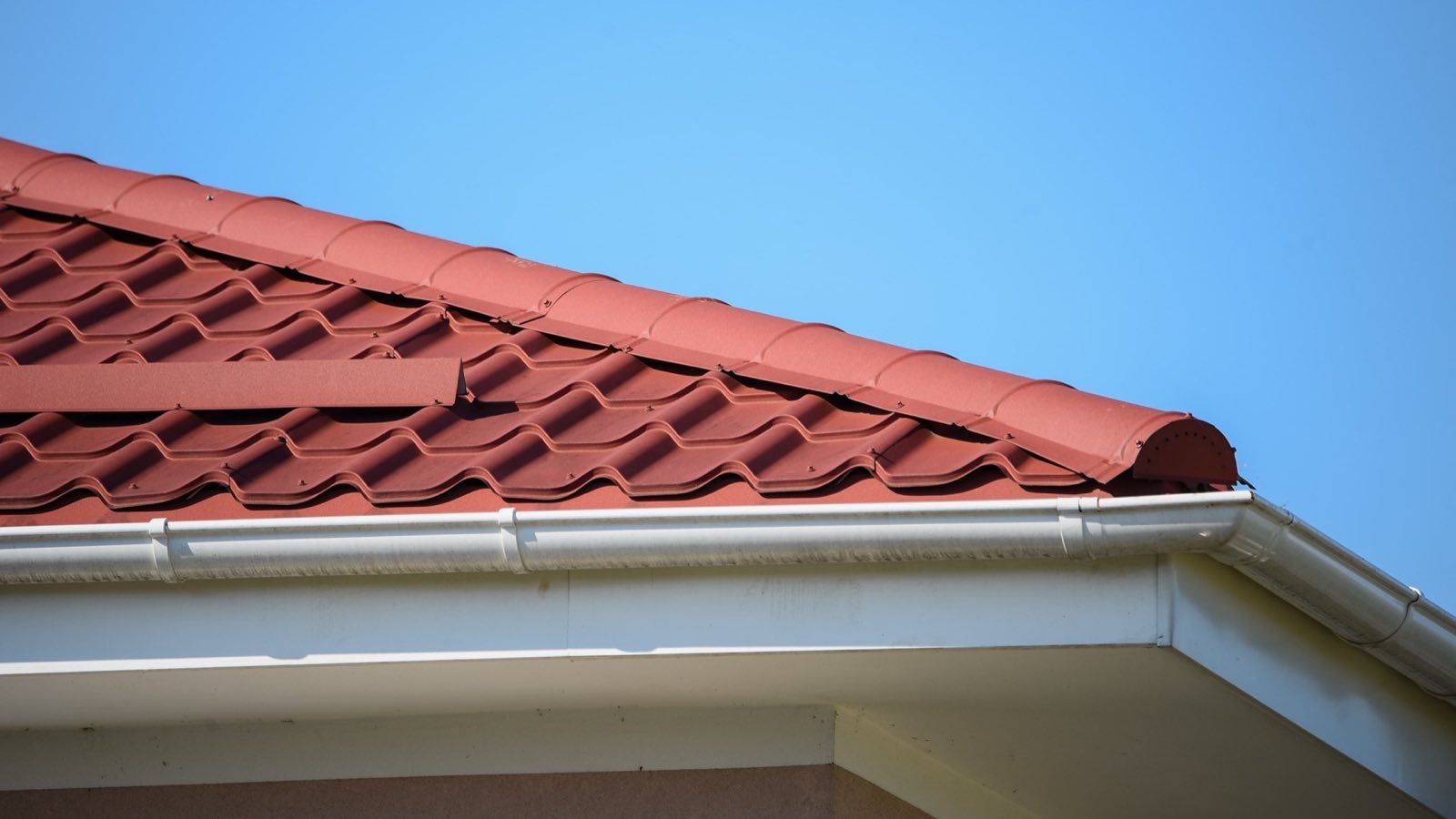
Accessories and Auxiliaries
Metal roof tile accessories
Flashings, valleys, ridge caps, snow guards and closure elements for the metal roof tile profiles.

20 accessories
-
01
 Eaves flashing
-
02
 Snow barrier
-
03
 Valley
-
04
 Ribbed ridge
-
05
 Ribbed ridge end cap
-
06
 Fascia cover profile
-
07
 Verge trim
-
08
 Top abutment flashing
-
09
 Anti-condensation membrane
-
10
 Half ridge
-
11
 Transition flashing – external
-
12
 Transition flashing – internal
-
13
 Snow guard
-
14
 Side abutment flashing
-
15
 Verge underflashing
-
16
 Sealing strips
-
17
 Bird guard
-
18
 Adhesive butyl tape
-
19
 Self-drilling screw
-
20
 Touch-up paint
What each accessory is for
- 01 Eaves flashing
- Installed on the timber board that supports the gutter system, after the gutter system has been fitted but before the anti-condensation membrane is laid. It is installed with a 5 cm overlap onto the gutter.
- 02 Snow barrier
- Used on steeply pitched roofs to prevent snow from falling off the roof surface. The pieces are installed in staggered, overlapping rows so that the whole slope is properly covered, and are positioned so that the weight of the accumulated snow is carried by the building structure.
- 03 Valley
- Installed at the junction of two roof slopes. A limit line is marked 70 mm from the valley axis, on both sides and along its whole length, which determines how far the tile panels cover the valley.
- 04 Ribbed ridge
- Used to close the intersection between 2 roof slopes, straight- or angle-mounted.
- 05 Ribbed ridge end cap
- Used to close off ribbed ridges. It is pre-drilled to ensure efficient ventilation.
- 06 Fascia cover profile
- Used to cover and seal the side fascia areas left exposed when the roof covering is installed.
- 07 Verge trim
- Used together with the verge underflashing / water deflector flashing to close off the side of the roof.
- 08 Top abutment flashing
- Used at the junction between a wall / blind wall and a roof slope, at an obtuse angle. The slope starts at the junction with the wall. The top abutment flashing is fixed into the wall.
- 09 Anti-condensation membrane
- An essential component of roof covering systems. Its role is to protect the roof assembly against water ingress and condensation and, thanks to its high vapour permeability, to keep the whole roof dry.
- 10 Half ridge
- Used to close off the top of the ridge area where a roof slope meets a vertical wall of the building.
- 11 Transition flashing – external
- Used at the transition from a gentler pitch to a steeper one, on the same roof slope.
- 12 Transition flashing – internal
- Used at the transition from a steeper pitch to a gentler one, on the same roof slope.
- 13 Snow guard
- Used on low-pitched roofs. Installed in a triangular pattern to gradually break up the mass of snow sliding off the roof.
- 14 Side abutment flashing
- Installed at the junction between a wall or blind wall and a roof slope, at a right angle. The slope runs along the wall. It is fixed into the wall.
- 15 Verge underflashing
- Installed along the verges of the roof, after the eaves flashing and before the tiles. Its role is to collect any water that gets in because the verge and the eaves of the roof are not perpendicular.
- 16 Sealing strips
- Used to close the junctions between roof planes where, because of the cut-outs and the shape of the metal roof tile, there could be spaces suitable for birds or large insects to nest. The ridge and eaves strips are perforated to let air through, so ventilation is not obstructed.
- 17 Bird guard
- Device allowing for the ventilation of the roof without obstructing the air flow, while also protecting against birds and large insects.
- 18 Adhesive butyl tape
- Makes it easy to resolve junction details between roof planes and acts as waterproofing
- 19 Self-drilling screw
- 4.8X20 mm - used for stitching the roof panels together and for fixing accessories to the panels and the components of the gutter system. 4.8X35 mm - used for fixing the roof panels (steel sheet) to the substructure made of vertical and horizontal battens.
- 20 Touch-up paint
- Used locally where roof panels or accessories have been scratched, and on edges cut with electric or hand shears.
